

For an OEM or ODM partnership, the bigger questions concern responsibility. Who develops the chair? Who approves component changes? Which test evidence covers the model you will sell? What happens when the first shipment arrives but the assembly video, spare-parts list or branded packaging is wrong?
This guide helps procurement and product teams answer those questions before committing to a private-label seating line. It builds on the broader framework for evaluating an ergonomic office chair manufacturer, with a closer focus on development decisions, commercial tradeoffs and launch readiness.
BUYER'S GUIDE
1. What does your chair line need to do in its selling channel?
Start with a one-page commercial brief, not a request for every model in the catalogue. State the destination market, intended users, target selling position, first-order quantity, forecast by SKU and required launch date. Add the features you will actually explain to customers.
A list reading “mesh, adjustable, ergonomic” leaves too much open. Specify which adjustments matter, the seat and back dimensions to review, the material direction, and the assembly or service experience your channel needs. Use the office chair adjustment guide to turn broad feature names into review questions.
The following are hypothetical buying situations, not GB customer case studies.
Retail and e-commerce: can customers understand and assemble it?
An online brand developing a mid-market mesh chair may prioritize a clear seat-depth story, easy-to-identify controls and packaging suitable for individual deliveries. Its evaluation should include unboxing, assembly instructions, adjustment videos, carton dimensions and replacement-part identification.
A showroom retailer may need finish consistency and a demonstration script more than parcel-oriented packaging. Confirm the actual distribution route; “retail packaging” does not describe a single packing method.
Commercial projects: can the supplier repeat the approved specification?
A dealer supplying a workplace project may need consistent finishes across phased deliveries, product-specific test files, installation information and parts support. A late switch in armrest or caster can matter even when the chair still looks similar.
Ask how the manufacturer keeps the approved configuration available for later phases, and what happens if a component becomes unavailable. Do not leave a substitute decision to the week before shipment.
Gaming brands: is differentiation useful beyond the appearance?
A gaming brand may want a distinctive colorway, headrest, recline behavior or breathable seating direction. Separate those requirements from unsupported claims about comfort or long-session performance.
Evaluate the intended users on the sample and check how the controls behave in the relevant seated positions. Then confirm that marketing images show the same accessories and configuration customers will receive.
BUYER'S GUIDE
2. Who owns the design work in an OEM or ODM partnership?
For this guide, OEM means manufacturing to a buyer-supplied design or agreed specification. ODM means working with a manufacturer-developed design, either an existing platform or a development project. Supplier usage varies, so write down the work rather than assuming the acronym settles it.
An existing chair sold under your label does not automatically become your exclusive design. Equally, paying for a prototype does not by itself establish ownership of every drawing or tool.
Ask the product team:
- Which features can change within the existing platform, and which require new engineering or tooling?
- Who prepares drawings, checks component compatibility and approves the production specification?
- What design files and physical samples will we receive at each decision point?
- Who owns the design, molds and development outputs, and what use is permitted after the relationship ends?
A useful R&D discussion should identify constraints. Changing a seat pan may affect the mechanism interface, packing size or evidence needed for the revised chair. Changing mesh tension may alter how the back feels. Ask the engineer to explain those consequences before treating each option as a simple catalogue upgrade.
Our OEM versus ODM office furniture guide expands the responsibility and ownership questions.
BUYER'S GUIDE
3. What does “factory-direct” mean for this office chair manufacturer?
Factory-direct should mean clear access to production responsibility, not a claim that the manufacturer makes every component itself.
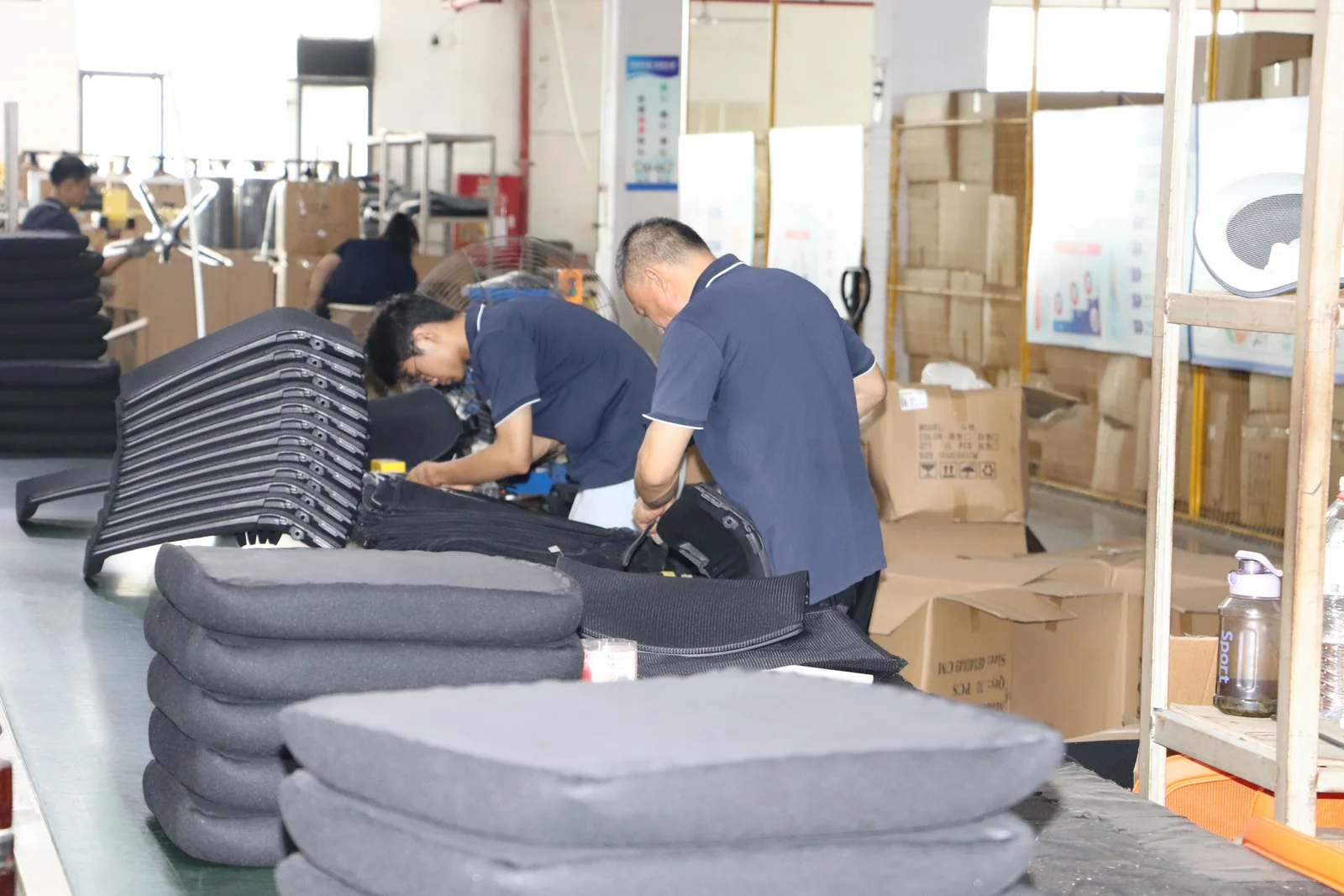
Chair programs can combine in-house seat work and assembly with bought-in gas lifts, mechanisms, casters, mesh or molded parts. Those purchases are not proof that the supplier is merely a trading company. What matters is whether sourcing, incoming checks, substitutions and finished-chair quality have accountable owners.
Request a walkthrough tied to your chosen category. Follow seat preparation, assembly, inspection and pack-out, and ask where bought-in components enter the process. Match the contracting entity, factory location and payment details through the supplier-verification process.
Warning signs include an unexplained production address, refusal to identify which work is subcontracted, test documents for unrelated models, or promises of any custom change without engineering review. Another concern is a salesperson who cannot connect an approved sample to the production team responsible for it.
Use the furniture factory verification checklist for a deeper review. A visit should resolve questions about your product, not just provide more photographs.
BUYER'S GUIDE
4. Which customization creates value—and which adds avoidable cost?
Compare customization in layers. Ask for the commercial and technical impact of each layer separately.
Branding on an existing configuration may include product labels, logo placement, carton artwork and instructions. Confirm setup charges, print minimums, artwork approval and whether the quoted packing is the one you need.
Material or component choices may include mesh, upholstery, armrests, bases or casters. Confirm compatibility and whether the choice changes supply lead time, minimum quantity, inspection criteria or testing scope.
Structural development may involve new molded parts, dimensions, mechanisms or tooling. Request development milestones and ownership terms before committing the investment.
The cost comparison should separate unit price from sample charges, tooling, validation, packaging development, content production and freight. Also ask whether MOQ applies per model, color, material or carton design. A manageable total quantity can still become difficult if spread across too many variants.
A useful planning calculation is:
One-time development cost per sellable chair = agreed one-time investment ÷ realistic sellable volume.
Use a cautious forecast, not a supplier's optimistic sales estimate. Separately consider inventory, inspection, logistics and service costs. The OEM quotation comparison guide helps keep the quote scope consistent.
For a first collection, one well-defined platform with a small number of meaningful choices may be easier to launch than several unrelated chairs. Original tooling makes more sense when an existing configuration cannot deliver a commercially important feature—not simply because “custom” sounds more premium.
BUYER'S GUIDE
5. What will the sample prove, and how is the schedule built?
A sample is useful only when its purpose is clear. Distinguish an existing-model sample, a revised development sample, and the sample approved as the reference for production.
Before dispatch, agree the configuration, unresolved items, sample cost, freight and review deadline. If a prototype uses a temporary component, mark that exception. It should not quietly become the reference for bulk production.
Review the sample across four areas:
- Product: dimensions, materials, finish and supplied accessories.
- Function and fit: controls, adjustment travel, recline operation and evaluation with the intended users.
- Assembly and service: instructions, hardware identification and replacement-part access.
- Evidence: specification revision, outstanding tests and the criteria for production approval.
Record feedback with photographs, measured observations and an owner for each correction. “Comfortable” or “looks good” alone is too vague to control the next batch. See the sampling and approval guide for the approval record.
An illustrative schedule—not a supplier lead-time promise
For an internal planning exercise, a buyer might allocate the following 12-week sequence to an existing-platform program. This assumes available components, no new structural tooling and a validation scope that the buyer and technical team have confirmed can fit. The allocations are an example, not an industry average or GB commitment.
- Weeks 1–2: brief and configuration review. Freeze the feature priorities, development route, quote assumptions and testing needs.
- Weeks 3–4: sample preparation and review. Allocate time for preparation, transit and buyer feedback; revise the calendar if shipping or materials require longer.
- Weeks 5–6: corrections and approval. Resolve sample issues, confirm documentation and approve packaging. Obtain the laboratory's actual schedule for any required work.
- Week 7: pilot and production release. Check the approved build and process before authorizing volume production.
- Weeks 8–10: production and content preparation. Run production checks while preparing assets from the frozen configuration.
- Weeks 11–12: inspection and shipment release. Complete the agreed inspection, corrections, packing checks and document handover.
Ocean transit, customs clearance and local availability sit outside this example. If new tooling, failed tests or unresolved compliance work is involved, rebuild the schedule around those dependencies. Never treat a calendar target as permission to skip an approval gate.
For GB specifically, request sample preparation and dispatch dates after the selected chair, changes and materials have been reviewed. A reliable answer should state what starts the clock and what can change it.
BUYER'S GUIDE
6. How will quality control preserve the approved chair?
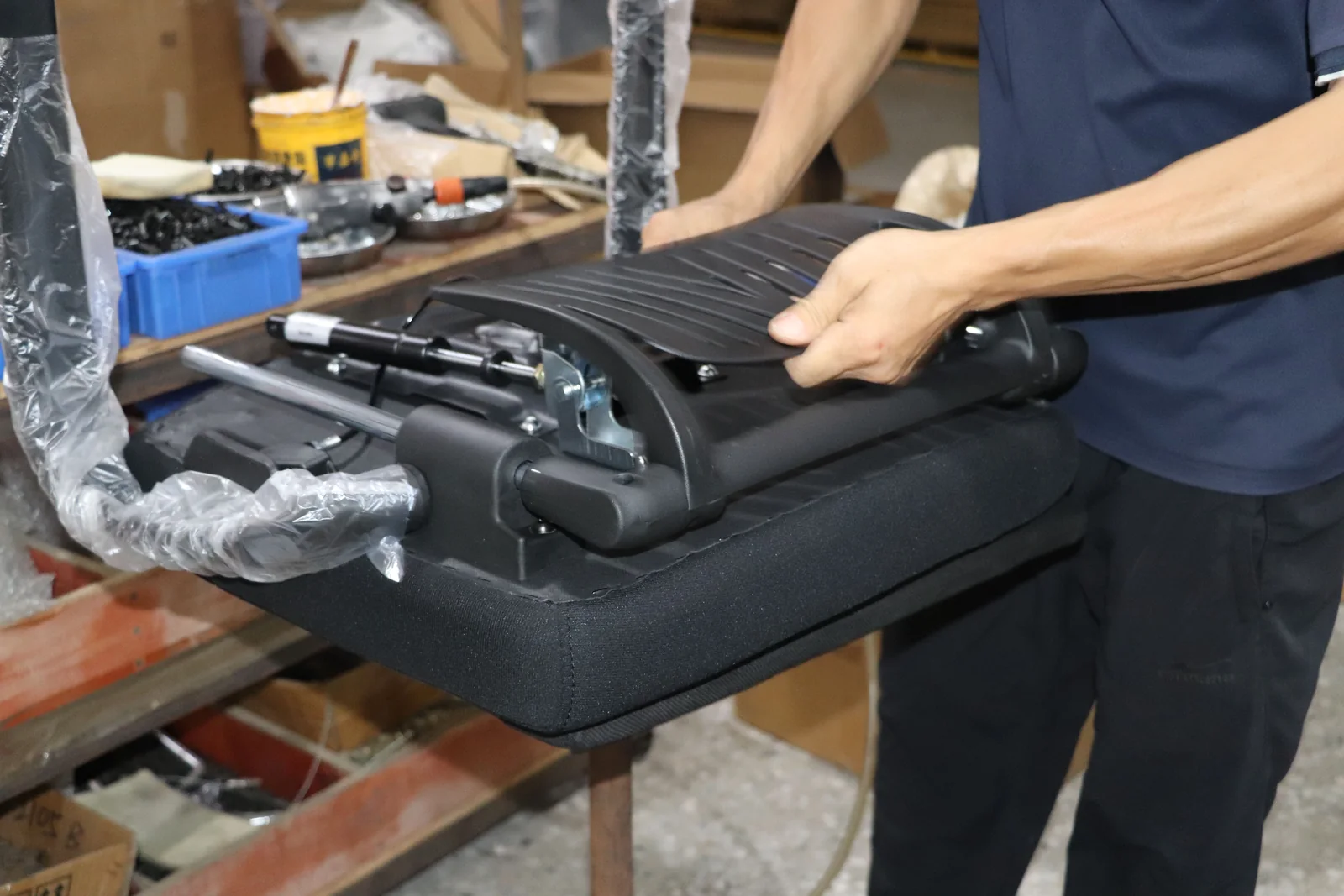
The sample should connect to a bill of materials, specification revision, manufacturing instructions and inspection criteria. Without that connection, “same as the sample” depends too heavily on memory.
Ask how the manufacturer identifies incoming components, checks important assembly steps, handles nonconforming items and links finished cartons to production batches. Request an example of the record used to release a batch, with confidential details removed where necessary.
Agree checks relevant to the chair: adjustment functions, fastener assembly, visible finish, supplied parts and packing completeness. Define major, minor and safety-critical defects before final inspection. An agreed statistical sampling plan does not replace the product's required safety assessment or mechanical testing.
Most importantly, require written approval for relevant material or component substitutions. The process should record the proposed change, cost and schedule effects, and any technical review or retesting needed. “Equivalent” is not a complete explanation.
Which standards and certifications apply to the actual chair?
Ask for evidence that matches the chair you plan to order, not a folder of certificate logos.
ANSI/BIFMA X5.1 addresses general-purpose office and institutional seating. BIFMA Compliant is a product verification program, not a blanket certification of a manufacturer's entire range. Confirm the report or registry scope and whether changes remain covered; BIFMA requires retesting after substantive product changes. BIFMA standards descriptions BIFMA Compliant verification rules
For office work chairs, EN 1335-1 concerns dimensions and their determination, while EN 1335-2 sets safety requirements, including strength and durability. Ask which parts and editions were used and which chair was tested. EN 1335 testing scopes
UL GREENGUARD and GREENGUARD Gold concern low chemical emissions; Gold uses lower VOC emission limits. They do not establish ergonomic fit or structural load performance. Those attributes require their own evidence. UL GREENGUARD certification
CE marking is required only when the specific product falls under EU rules that mandate it. It is not a universal quality certificate for mechanical office chairs. Determine the applicable rules before requesting a mark or declaration. EU CE-marking guidance
Have the relevant laboratory or your compliance team confirm applicability for the destination, materials and configuration. These references do not establish that a particular GB model is certified.
BUYER'S GUIDE
7. What sales-ready assets will be delivered with the chair?
A private-label chair is not launch-ready just because its carton is ready. Your sales team needs accurate product information, and your customers need instructions that match what they receive.
Define a content package with specific outputs:
- Product photographs showing the approved configuration, plus useful detail views.
- Dimension and adjustment information in the units your channel uses.
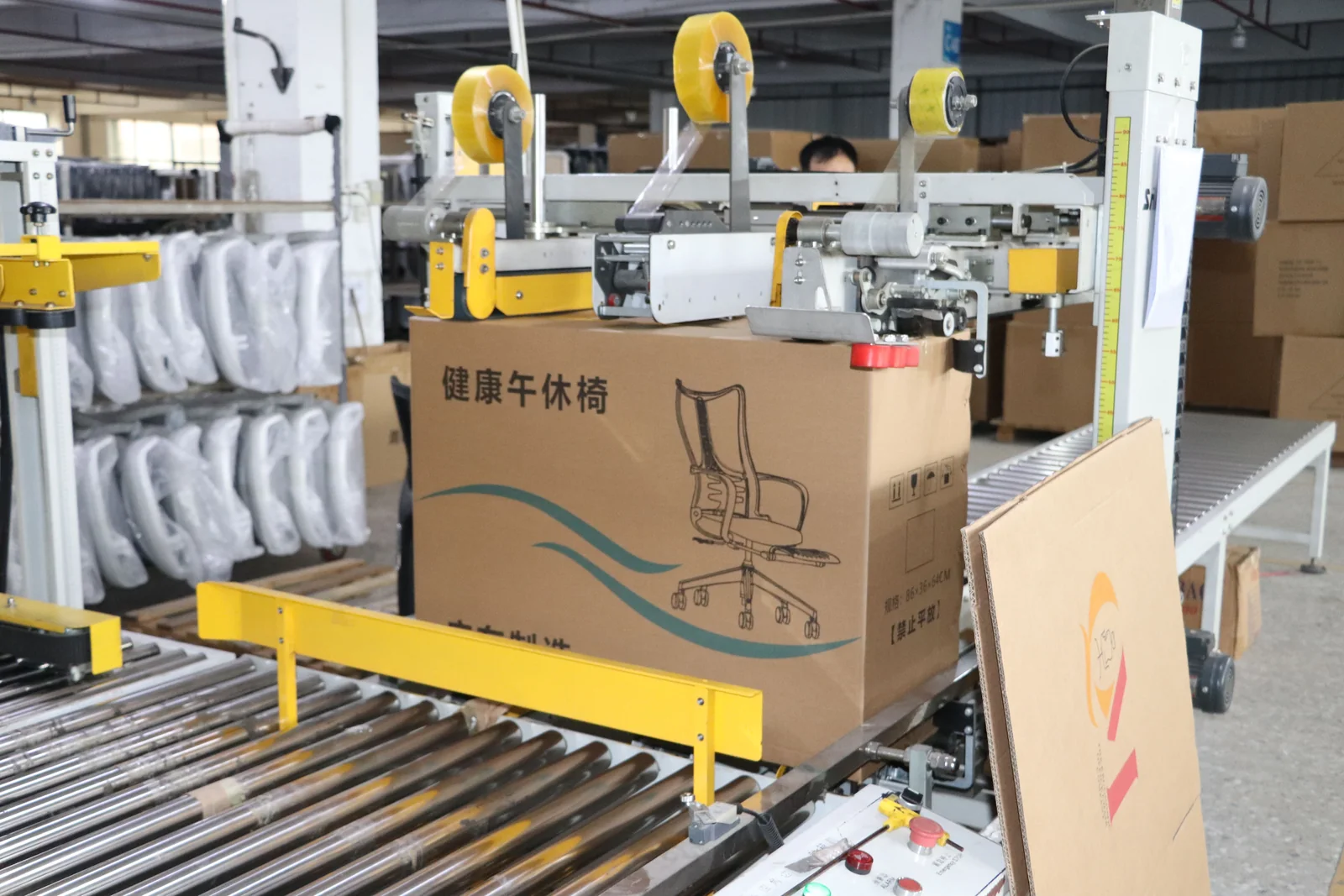
- Assembly instructions and a parts list linked to the actual packing arrangement.
- Adjustment or feature videos demonstrating the supplied mechanism and controls.
- Branded specification sheets, packaging artwork and approved copy for supported product claims.
Specify file formats, language, revision dates, delivery dates and permitted use. Establish whether raw footage or editable files are included, who owns new work, and whether images may be used by other buyers.
Keep this package tied to the approved product version. A later armrest change can make a photograph inaccurate; a packing change can make the assembly guide confusing. Name the person responsible for updating both product and content files.
For gaming brands, prioritize demonstrations over unsupported performance slogans. For commercial dealers, useful technical files may matter more than lifestyle photography. For online sellers, a clear unboxing and adjustment sequence may be more useful than additional hero images.
BUYER'S GUIDE
8. What happens after approval, delivery or a product change?
Agree commercial responsibilities before the sample becomes a production order. Clarify the delivery milestone, payment conditions, inspection rights, warranty scope, claims procedure and spare-parts arrangements.
A factory warranty does not automatically provide local labor, consumer returns or replacement delivery in your market. Decide which party handles those services and how costs are approved. Ask how long relevant parts can be supplied, what happens when a part is discontinued, and how a batch issue is investigated.
For protected designs, separate confidentiality from ownership and exclusivity. An NDA can restrict information disclosure, but design rights, tooling access and any territory or channel restrictions need their own agreed scope. Have appropriate counsel review important provisions.
Also establish who can approve changes. A purchase order, revised sample and carton artwork should not describe three different chairs. Keep the final configuration, approval record and change history together.
BUYER'S GUIDE
GB Ergonomic: a factory-direct partnership profile
GB Ergonomic is the B2B brand of Foshan Xinguibin Intelligent Furniture Co., Ltd., based in Foshan, China. Its published factory workflow shows chair cover preparation, sewing, seat production, assembly and packing alongside a separate standing-desk program. GB factory workflows
For a seating partnership, that is a starting point for reviewing the selected chair's actual production path. The next discussion should connect product priorities to the development team, sample specification, quality checks and commercial plan.
What to request from GB for your launch
Share the selling channel, destination market, intended users, required adjustments, material direction and estimated quantity by variant. Request a written response covering the proposed platform, development responsibilities, sample plan, evidence available for that configuration and open items before production.
Add the content deliverables your team needs: product images, dimensions, instructions, feature videos and private-label files. GB's published partner program allows this work to be scoped around a selected line, including launch-content and website direction. Availability, pricing, usage rights and handover dates must be agreed for the program. GB partner-support scope
Disclosure: This is GB Ergonomic brand editorial content. The profile describes published capabilities, not an independently audited recommendation or a completed customer case study. Sample dates and content packages require project confirmation.
GB's project and order support resource explains its approach to sample decisions, production communication and issue response. Use it to prepare the responsibilities you want confirmed in your own agreement. GB project-support resource
Use this checklist to decide whether to proceed with development or sampling. Keep unresolved items visible rather than treating silence as acceptance.
- Channel, intended users, destination and launch objective are defined.
- The selected chair configuration and requested changes are documented.
- Design, engineering, tooling and approval responsibilities are assigned.
- Production scope, bought-in components and substitution controls are understood.
- Sample purpose, price, freight, dates and acceptance criteria are agreed.
- Test documents have been matched to the model and required configuration.
- MOQ by variant, one-time costs and quoted packaging are clear.
- Pilot, inspection and production-release decisions have named owners.
- Content files, usage rights and update responsibilities are specified.
- Warranty, parts, claims and shipment-handover terms are written down.
Do not average away a missing safety document or an unresolved rights issue because the supplier scored well on price. Close those gaps before the affected stage is authorized.
FREQUENTLY ASKED QUESTIONS
Questions to settle before you request a quotation.
What is the difference between an OEM and an ODM office chair manufacturer?+
An OEM arrangement follows buyer-supplied designs or agreed specifications. An ODM arrangement uses manufacturer-developed designs, from an existing platform or a new development brief. Actual responsibilities vary, so confirm engineering work, tooling, ownership and approval rights in writing.
How long should office chair sampling take?+
There is no single reliable timeline for every chair project. Existing-model samples, material changes and new structural prototypes involve different dependencies. Request preparation, dispatch and review dates for the selected configuration, including component availability, revisions and any testing needed. Do not confuse sample lead time with production or transit time.
What MOQ should a private-label chair brand expect?+
MOQ depends on the chair platform, components, materials, colors, branding and packaging. Request quantities per variant and any separate material or printing minimums. Confirm mixed-model feasibility and one-time development costs instead of relying on one factory-wide number.
Does GREENGUARD certification prove that a chair is ergonomic?+
No. UL GREENGUARD concerns low chemical emissions, not ergonomic fit or structural strength. Evaluate dimensions and adjustments for the intended users, and review the applicable mechanical test evidence separately.
Can a manufacturer provide photos and videos for a private-label launch?+
Some manufacturers offer existing assets or scoped content production. Agree the exact product version, deliverables, language, file formats, usage rights, price and delivery dates. GB Ergonomic can discuss a program-specific package; it is not an automatic entitlement attached to every order.
RELATED BUYER GUIDES
Continue with the next practical question.
Each guide below develops the product, evidence or commercial question that naturally follows this one.
MANUFACTURER SHORTLIST
Top 10 Private-Label Office Chair Manufacturers for Online Retail Brands
Compare 10 office chair manufacturing candidates for online retail OEM launches, with packaging, assembly, SKU data, media rights and spare-part checks.
MANUFACTURER SHORTLIST
Top 10 Task Chair Manufacturers in China for Commercial Seating Programs
Compare China task chair manufacturers for commercial seating: SKU control, user-fit trials, batch changes, replacement parts and repeat orders.
ERGONOMIC SEATING
Top 10 Ergonomic Office Chair Manufacturers in China (2026)
Compare 10 ergonomic office chair manufacturers in China, with GB featured first, OEM and dealer routes, adjustment evidence and model-report checks.
READY TO MAKE A MORE INFORMED DECISION?
Start with a chair brief your factory can act on
Send your destination market, sales channel, required features, estimated quantities and purchasing window. State whether you need an existing private-label platform or a more original development route, and list the sales assets your team needs at launch. We will clarify the relevant configuration, sampling and partner-program scope.
Get a focused responseSOURCES AND FURTHER READING
The references below support the standards, procurement and workplace context in this guide. Requirements should always be verified against the exact product configuration, destination market and commercial arrangement.
- BIFMA — Standards Descriptions
- BIFMA — Product verification program and change-sensitive testing
- Furnitest — EN 1335 office work chair testing scopes
- UL Solutions — GREENGUARD Certification
- Your Europe — CE marking applicability
- GB Ergonomic — Factory and production workflows
- GB Ergonomic — Partner launch support and sales-content scope
- GB Ergonomic — Project and order support
ABOUT THIS GUIDE
Written by the GB Ergonomic Editorial Team and reviewed on November 10, 2026. This is an educational buyer resource, not legal, certification or regulatory advice. Product evidence, standards and commercial terms should be confirmed for the exact configuration and destination market.