BUYER'S GUIDE
OEM vs ODM Office Furniture: What Do the Terms Mean?
OEM and ODM are commercial shorthand for different starting points. The practical distinction is the level of buyer design input and supplier development work, not an automatic rule about quality or ownership. The project record should identify who proposes, approves, supplies, and retains each item.
OEM In a Private-Label Furniture Project
In a typical OEM arrangement, the buyer provides a defined brief: drawings, dimensions, materials, component requirements, branding artwork, or a controlled sample. The supplier evaluates manufacturability and produces to the agreed specification. Any material substitution or engineering change should follow the agreed change process, not be assumed from the OEM label.
ODM In a Private-Label Furniture Project
In a typical ODM arrangement, the supplier begins with an existing product platform or contributes more design and development work. The buyer may select configurations and request permitted changes to colours, upholstery, branding, packaging, or accessories. A hybrid project can combine a supplier platform with buyer-led dimensions, finishes, or a new feature.
An ODM platform can be a useful starting point, but it does not prove that every feature, market, or variation is available. Ask which platform version is proposed, what changes are technically possible, and which change requires new development.
<figure>

<figcaption>GB office furniture factory overview. The image shows a production setting, not a specific private-label project's design, rights, or specifications.</figcaption>
</figure>
BUYER'S GUIDE
The Practical Difference Is Who Contributes, Controls, and Approves
Map the work before comparing labels. A buyer can have significant input in an ODM-derived product, and a supplier can make meaningful contributions to an OEM-led design. The record should show who supplied the starting material, who approves a revision, and what marks a release.
A private-label brand should also separate commercial roles from market-facing duties. UK guidance says businesses that make, import, distribute, or sell consumer products are responsible for safety and labelling requirements. UK Office for Product Safety and Standards Allocate compliance-document tasks by market and role rather than relying on OEM or ODM.
Map the Work Before Comparing Labels
Use this responsibility matrix early. Confirm the approval owner in writing.
| Work Item | Buyer Input or Approval Needed | Supplier Contribution or Evidence Requested | Record to Control |
|---|---|---|---|
| Product brief | User, channel, market, and configuration | Feasibility questions and assumptions | Brief version |
| Design files | Drawings, artwork, sample, or open questions | Review or platform details | File register |
| Prototype or sample | Acceptance criteria and feedback | Sample identification and variance record | Approval record |
| Product change | Written request | Technical impact and assumptions | Revision log |
| Market documents | Destination and route to market | Available documents for the configuration | Document list |
| Production release | Approved configuration | Confirmation of released specification | Release record |
EU guidance illustrates why this matters: an entity placing a product on the market under its own name or trade mark can be a manufacturer, while importers have separate duties. European Commission: General Product Compliance Requirements depend on product, market, and role.
BUYER'S GUIDE
OEM vs ODM Office Furniture: A Side-by-Side Comparison
These are common arrangements, not automatic entitlements. The agreement should turn every “to be confirmed” item into a defined scope.
| Decision Area | OEM: Common Arrangement | ODM: Common Arrangement | What the Project Must Confirm |
|---|---|---|---|
| Design source | Buyer supplies a defined design or specification | Supplier starts with an existing platform or leads development | Starting files, platform version, and permitted use |
| Buyer input | Detailed specification and approvals | Selection, branding, and permitted modifications | Required inputs and decision dates |
| Development | Supplier may adapt for manufacture | Supplier may provide platform development | Deliverables, reviews, and acceptance criteria |
| Customisation | Can range from minor changes to a new design | Often bounded by platform components | What may change and what needs development |
| Rights | Not determined by the label | Not determined by the label | Background rights, project work, files, and licences |
| Exclusivity and tooling | Not implied | Not implied | Coverage, payment, use, duration, and end-of-project treatment |
| Changes and exit | Buyer approval may be central | Platform changes may need controls | Approval, traceability, and transition terms |
BUYER'S GUIDE
When Is OEM a Better Fit for Your Furniture Brand?
OEM can fit a brand with a manufacturable office furniture design, controlled specification, or defined architecture to preserve. It can also fit where close control over materials, components, branding, and changes is necessary.
It is not automatically the “higher-protection” option. Before choosing OEM, confirm that you can answer these questions:
- Are files and specifications ready for supplier review?
- Which features need written approval to change?
- Can we resolve conflicts between drawings, samples, and feedback?
- Have we planned controlled sample iterations?
- Do we know the rights needed after the relationship ends?
If important answers remain open, begin with a staged development brief or a hybrid model. You can explore the current office furniture range, but suitability remains configuration- and project-specific.
<figure>
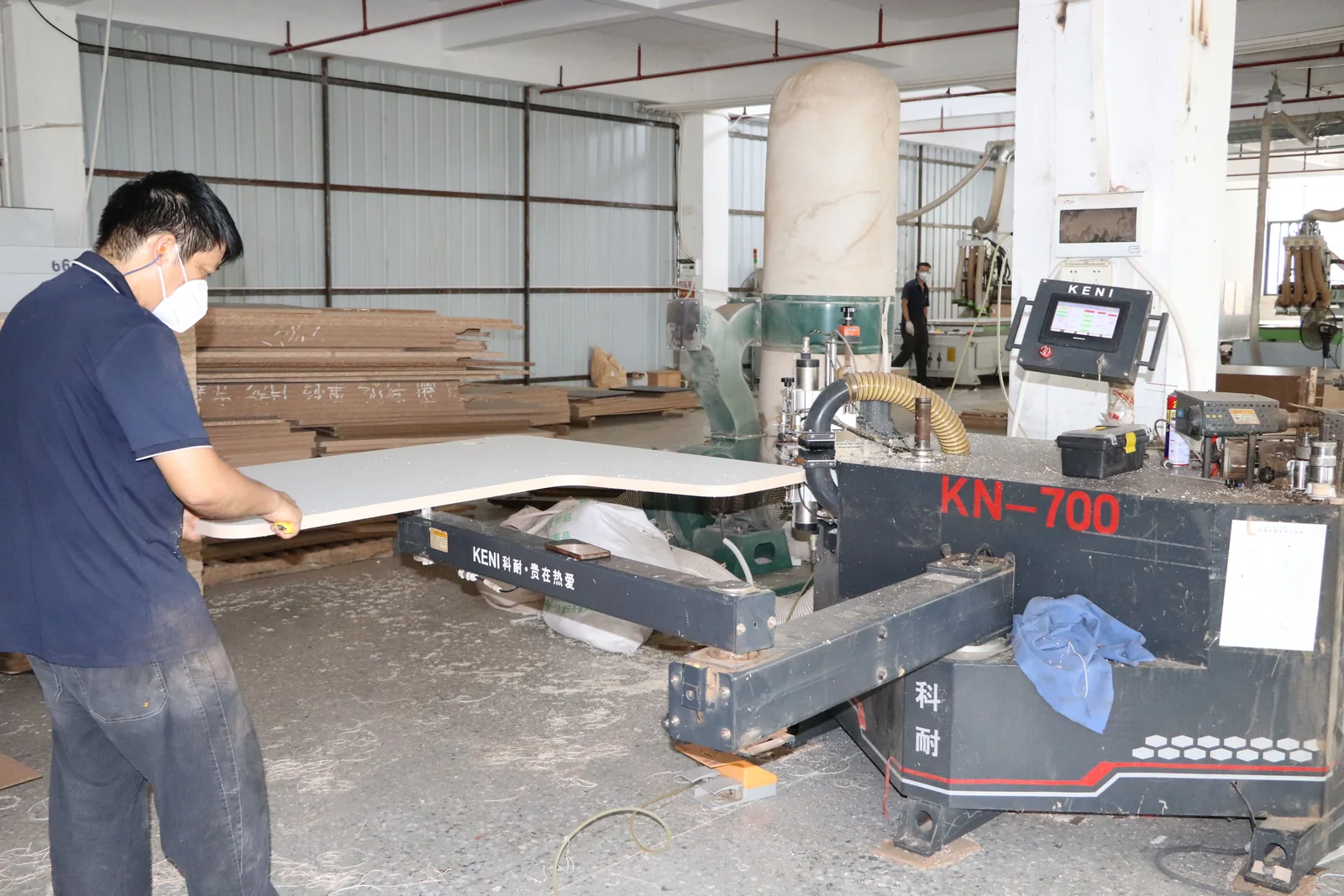
<figcaption>Tabletop machining in a GB furniture production process. It shows one manufacturing activity, not a claim about a buyer’s design rights or configuration.</figcaption>
</figure>
BUYER'S GUIDE
When Should You Consider ODM or a Hybrid Model?
Consider ODM when a supplier platform offers a viable starting point and differentiated requirements are within a defined scope. A hybrid approach can pair an existing platform with buyer-selected finishes, packaging, features, or a new component. Define the boundary between platform work, buyer customisation, and new development.
Define What “Custom” Means for This Project
“Custom” is not enough for a quote. Break it into individual decisions and record the response for each one.
| Customisation Type | Question for the Brief |
|---|---|
| Appearance | Which colour, finish, upholstery, or logo detail is requested? |
| Dimensions | Which measurements or desktop sizes are proposed? |
| Branding | Which artwork, labels, manuals, and packaging elements apply? |
| Function | What feature, component, control, or accessory must change? |
| Packaging | What pack format, marks, inserts, and handling information apply? |
| Market readiness | Which market and route are planned, and who confirms applicable requirements? |
For US consumer products subject to CPSC rules, the manufacturer or importer must certify compliance; for overseas manufacture, CPSC guidance says the importer issues the General Certificate of Conformity where required. U.S. Consumer Product Safety Commission A supplier document, sample, or ODM label does not transfer that responsibility.
BUYER'S GUIDE
Resolve Design Ownership, Exclusivity, Tooling, and Revisions in Writing
OEM or ODM does not decide who owns a drawing, how a supplier may use a platform, whether a buyer gets exclusivity, or what happens to project-specific tooling. These agreement questions need qualified legal review.
IP Australia says an Australian design right concerns the visual appearance of a new and distinctive physical product; it does not by itself protect function or a brand name. IP Australia: What Are Design Rights? A design discussion or tooling payment is not a substitute for a rights review.
Separate Background IP From Project-Specific Work
Create an inventory before development begins. Background material may include a supplier platform, buyer artwork, or existing CAD files. Project work may include drawings, packaging art, or a new component. For each item, address permitted use, ownership or licence, confidentiality, third-party rights, file access, and termination. If exclusivity is discussed, state the product, territory, channel, duration, conditions, and exceptions.
Make Revision Control Traceable
Use a revision register linking each change to files, samples, components, packaging, market documents, and approvals. Require written acceptance before a material change enters the released configuration. CPSC guidance notes that material changes to design, process, or component source may affect compliance with applicable requirements. U.S. Consumer Product Safety Commission
For shipping, name the chosen Incoterms® rule and place. ICC explains that Incoterms® 2020 allocates tasks, costs, risks, and obligations between buyer and seller. International Chamber of Commerce It does not replace an agreement on product rights, acceptance, or after-sales responsibilities.
BUYER'S GUIDE
A Buyer’s Decision Framework Before Requesting a Quote
Select a starting model that matches your preparation and control needs, then verify the supplier separately. This is not technical, legal, or compliance advice.
| If Your Situation Is… | Useful Starting Model | Questions Before You Proceed |
|---|---|---|
| Controlled, manufacturable files and close control | OEM | Can the supplier make the configuration? Who owns new adaptations and files? |
| An existing chair or desk platform is preferred | ODM | Which platform version is offered, and what is customisable? |
| An existing platform needs meaningful buyer-led changes | Hybrid | Where does the platform end and project development begin? |
| Design, market, or rights requirements remain unclear | Discovery before model selection | What evidence and decisions are missing before a dependable quote? |
A model choice is not factory verification. Once scope is visible, use a separate process for how to verify an office furniture OEM factory. Australian buyers should also map market responsibilities early: the ACCC states that consumer products must be safe and businesses must comply with applicable mandatory standards and bans. Australian Competition and Consumer Commission
BUYER'S GUIDE
Questions to Put in Your OEM or ODM RFQ
An RFQ should make a model label answerable. Keep questions specific enough that every supplier responds against the same project version. For a full template, see office furniture RFQ fields and quote comparison.
| RFQ Topic | Question to Ask |
|---|---|
| Design source and version | What files, sample, or platform version forms the basis of the quote? |
| Development deliverables | Which drawings, samples, reviews, or records are included, and who approves them? |
| Customisation | Is each change available, subject to development, or excluded? |
| Rights and confidentiality | What needs an agreed licence, assignment, confidentiality treatment, or third-party clearance? |
| Tooling and exclusivity | What is project-specific, and which terms need separate agreement? |
| Samples and revisions | How will samples be identified, feedback recorded, and changes approved? |
| Quote and market scope | What is included or excluded, which delivery term applies, and which market is planned? |
Save the brief, artwork, drawings, and questions in a controlled folder. The buyer should state which version was priced and which assumptions remain open. For planning material, see resources; the project record remains the source of truth.
FREQUENTLY ASKED QUESTIONS
Questions to settle before you request a quotation.
Is OEM or ODM Better for a Furniture Brand?+
Neither is automatically better. OEM can fit a brand with a clear, manufacturable design and a need for close specification control. ODM can fit a brand starting from a supplier platform. Choose after assessing design readiness, development needs, desired control, and written project terms.
Who Owns the Design in an OEM or ODM Furniture Project?+
The model name does not determine ownership. Identify pre-existing material and project work, then agree in writing on ownership or licence rights, permitted use, confidentiality, file access, and termination. Obtain qualified legal advice for the applicable jurisdictions.
Can a Buyer Customise an ODM Furniture Design?+
Possibly. The scope depends on the supplier platform, options, engineering constraints, and written agreement. Define each appearance, dimension, branding, packaging, or functional change and ask whether it is available, requires development, or is excluded.
Should Tooling and Exclusivity Be Included in the Agreement?+
Raise them explicitly when relevant; neither is implied by payment or an OEM/ODM label. State the covered tooling or variation, payment and use terms, territory or channel, duration, conditions, and end-of-relationship treatment.
Does a Private-Label Brand Take on Product-Safety Responsibilities?+
Responsibilities depend on product, market, and supply-chain role. Official guidance in the US, UK, Australia, and the EU places duties on different actors. Identify the market and role early, allocate tasks in writing, and seek appropriate advice before market entry.
RELATED BUYER GUIDES
Continue with the next practical question.
Each guide below develops the product, evidence or commercial question that naturally follows this one.
PRODUCT DEVELOPMENT
How to Build a Private-Label Standing Desk Program Without Losing Your Brand Distinction
Build a differentiated desk program from platform decisions, sample control and launch-ready evidence.
OEM / ODM SEATING
How to Choose an Office Chair Manufacturer: Key Questions for OEM and ODM Partnerships
Choose an office chair manufacturer for OEM or ODM. Ask about design, samples, quality evidence, private-label costs and sales-ready launch assets.
FACTORY VERIFICATION
How to Verify an Office Furniture OEM Factory Before You Order
Check legal identity, production scope, quality records and subcontracting before committing an order.
READY TO MAKE A MORE INFORMED DECISION?
Request a Scoped Quote or Procurement Review
If you are evaluating an OEM, ODM, or hybrid office furniture project, [contact GB Ergonomic](/contact) with the target product, current design inputs or development scope, and destination market. We can discuss the scope of an OEM or ODM review; product configuration, documentation, and commercial terms remain subject to project-specific confirmation.
Get a focused responseSOURCES AND FURTHER READING
The references below support the standards, procurement and workplace context in this guide. Requirements should always be verified against the exact product configuration, destination market and commercial arrangement.
- UK Office for Product Safety and Standards — Product Safety Advice for Businesses
- European Commission — General Product Compliance
- U.S. Consumer Product Safety Commission — General Use Products: Certification and Testing
- Australian Competition and Consumer Commission — Product Safety Responsibilities
- IP Australia — What Are Design Rights?
- International Chamber of Commerce — Incoterms® 2020
ABOUT THIS GUIDE
Written by the GB Ergonomic Editorial Team and reviewed on October 27, 2026. This is an educational buyer resource, not legal, certification or regulatory advice. Product evidence, standards and commercial terms should be confirmed for the exact configuration and destination market.