
BUYER'S GUIDE
What Is Office Chair Seat Depth, and Why Does Fit Matter?
Seat depth is the usable front-to-back distance of the seat in a stated chair position. It is different from seat height, seat width, and overall chair depth. The fit question is practical: can the user sit back while the seat supports most of the thigh without uncomfortable contact at the back of the knee?
The U.S. Occupational Safety and Health Administration (OSHA) notes that a seat pan that is too short can leave taller users with inadequate leg support, while one that is too long can contact the knee area for shorter users and reduce back support. OSHA advises support for most of the thigh without contact between the seat front and the back of the knee (OSHA chair guidance).
The result also depends on the workstation. Foot support, chair height, backrest position, desk height, keyboard reach, and the task can change what works for a user. A catalog dimension is therefore a screening input, not proof that one chair fits every user. For a wider selection framework, see the ergonomic office chair buying guide.
BUYER'S GUIDE
How Should Buyers Measure an Office Chair’s Seat Depth?
Buyers should measure seat depth only after confirming the manufacturer’s endpoints and chair state. A number without a defined method is not reliably comparable with another supplier’s drawing, sample, or product listing.
A controlled record should identify endpoints, cushion condition, seat and backrest position, adjustment setting, unit, model, configuration, and document revision. A sliding seat can have a nominal pan measurement and an adjustable effective depth; they are not the same figure.
Confirm the Measurement Points and Method
Request an annotated drawing, specification, or measurement instruction that marks the endpoints. Record upholstery, cushion, and seat-slide conditions that change the usable surface.
OSHA’s purchasing guidance explains that effective depth may be adjusted by a sliding seat pan or by a backrest that moves horizontally forward and backward. A backrest that only tilts is not necessarily an effective-depth adjustment (OSHA purchasing guide).
Record Units, Configuration, and Source
Retain the source unit when converting between millimeters and inches. A photograph of a similar chair, an undated listing, or a verbal statement does not replace a configuration-specific drawing or manual. If the endpoints, range, or adjustment method are missing, mark the field “to be confirmed” rather than filling it from a related model.
BUYER'S GUIDE
What Fit Signals Should a User Check While Seated?
A seated assessment should check foot support, thigh contact, clearance behind the knees, and backrest contact together. The purpose is to observe whether the chair and workstation allow a stable, supported working position, not to prescribe one posture for every person.
Have the user sit back as they would for the actual task. Check whether the feet are supported on the floor or an appropriate footrest, whether the thighs are supported, and whether the backrest can be reached without perching forward. Then observe whether the seat front creates uncomfortable pressure behind the knees. CCOHS includes flat feet, lower-leg clearance, and backrest adjustment in its practical chair-fitting sequence (CCOHS).
Official sources use different clearance cues. HSE shows a 2–3 cm gap, while CCOHS and NIH use a fist-size cue (HSE; NIH). These are observation prompts, not a universal product specification or medical rule. The chair and workstation affect the result.
A purchasing review is not a diagnosis. Where a user has persistent pain, numbness, a disability, or another individual accommodation need, seek suitable qualified advice.
BUYER'S GUIDE
How Does Seat-Depth Adjustment Work on a Specific Chair?
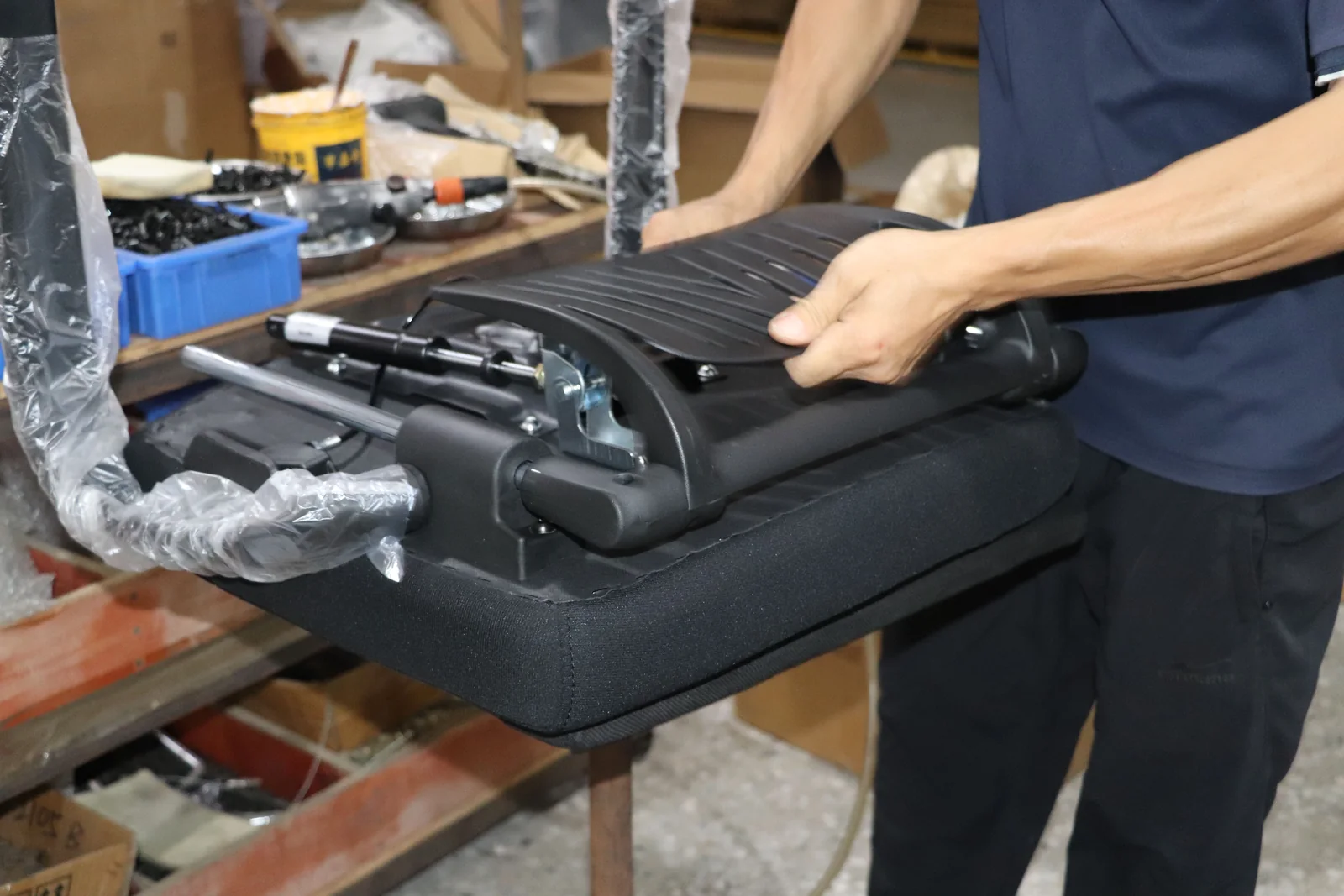
Seat-depth adjustment changes the relationship between the seat front and the backrest, but mechanisms vary. Establish whether the exact configuration has an effective-depth adjustment, then check the control, available positions or range, and user instructions.
A sliding seat pan moves forward and backward. A backrest that shifts horizontally relative to a fixed seat can also change effective depth. Recline and tilt change angles, so they should not be described as a seat-depth adjustment unless the product documentation specifically says they change the relevant front-to-back relationship.
Identify the Adjustment Type and User Instructions
Review the manual for the exact model and configuration. It should identify the control, its operating conditions, and any cautions. If a sample is available, have an intended user operate the control while seated and record the sample identity and observed setting. Do not infer a mechanism or travel range from a product photograph.
Verify the Published Range Against the Exact Configuration
Different arm, seat, or back options can change what “adjustable” means. Record the feature as “present,” “not present,” or “to be confirmed,” and add a range only when an applicable specification or approved measurement record supports it. A seat slide can help a varied user group trial fit; it does not establish that every user will achieve a suitable fit.
BUYER'S GUIDE
How Can Buyers Match Seat-Depth Requirements to a User Group?
For a group purchase, ask which people, tasks, and workstations the chair must accommodate rather than asking for one best seat depth. CCOHS states that there is no “average” person and presents adjustability as a way to accommodate a range of users (CCOHS).
Where practical, use representative users and the actual desk or comparable work surface. Ask participants to try the normal task, change the seat-depth setting, and record: feet supported, thighs supported, no uncomfortable knee-back pressure, and backrest contact. Add the chair configuration and workstation condition.
WorkSafe Queensland connects chair fit, leg length, and desk access. It advises thigh support, clearance behind the knee, and a position close enough to the desk to avoid over-reaching (WorkSafe Queensland). This helps organize a trial; it does not map height to a chair model. Avoid unnecessary health information when task and fit observations serve the commercial review.
BUYER'S GUIDE
What Evidence Should Buyers Request Before Comparing Chair Models?
Before comparing seat depth or adjustment, request a like-for-like evidence package. It should identify the exact model and configuration, define the measurement method, state whether effective depth is adjustable, and cite the controlled document version. If those fields do not match, a numerical comparison can mislead.
| Comparison Field | What to Record or Verify | Do Not Assume |
|---|---|---|
| Model / configuration | Exact model, options, seat construction, and revision | A photo or range name represents the quoted chair |
| Seat-depth definition | Endpoints, seat/backrest state, cushion condition, and method | All suppliers measure from the same points |
| Seat depth / unit | Controlled drawing or specification value, unit, and version | A catalog number is directly comparable |
| Seat-depth adjustment | Present, absent, or to be confirmed; adjustment type | An “ergonomic” label means a seat slide is fitted |
| Range / method | Approved range and operating method, if documented | The same range applies to every configuration |
| User-fit observations | Trial setting, user group, workstation, and non-medical notes | One trial proves fit for all users |
| Source / open issue | File title, date or revision, reviewer, and unresolved question | Missing information can be borrowed from another model |
For supplier due diligence beyond chair specifications, see how to verify an office furniture OEM factory. Any GB Ergonomic dimension or adjustment detail should be confirmed against applicable product documents before publication or selection.

BUYER'S GUIDE
How Does Seat Depth Interact With Other Chair Adjustments?
Seat depth should be checked with seat height and backrest position because one adjustment can change the relationship with the others. A user who moves a seat pan rearward for knee clearance should recheck thigh support and foot support at the work surface. OSHA notes that a footrest may be needed when the chair height required for the task leaves feet unsupported (OSHA chair guidance).
This does not make a chair with more controls inherently better. It means each relevant control needs an observation in the intended setup. For seat height, armrests, recline, and other controls, see office chair adjustments explained. For surface construction and care, see mesh vs. upholstered office chair materials.
BUYER'S GUIDE
A Practical Office Chair Seat-Depth Fit Checklist
Before selecting a chair or narrowing a B2B shortlist:
- Identify the target model, configuration, intended market, and current document revision.
- Ask how seat depth is defined and where the measurement starts and ends.
- Record the seat and backrest position used for every stated measurement.
- Confirm whether effective-depth adjustment is present, how it works, and any documented range.
- Trial the exact or representative configuration at the intended work surface where possible.
- Record foot support, thigh support, knee-back clearance, backrest contact, and desk access as general observations.
- Keep measurement evidence separate from user-trial notes; neither replaces the other.
- Hold unknown dimensions, mechanisms, or configuration differences as open questions before comparing suppliers.
When a buying team needs to turn this record into a commercial request, the office furniture RFQ and quotation comparison guide can help align configurations, document revisions, and supplier responses.
Send user-fit requirements to GB for model/spec review. Send your user-fit requirements and target chair configuration to GB Ergonomic for a model- and specification-specific review. Any dimensions or adjustment details shared should be confirmed against the applicable product documents before publication or selection. A contact route or product inquiry page should be confirmed by the site editor before this CTA is published.
FREQUENTLY ASKED QUESTIONS
Questions to settle before you request a quotation.
How Do You Measure Office Chair Seat Depth?+
Confirm the manufacturer’s endpoints and chair state first. Record where the measurement starts and ends, whether the seat pan or backrest is adjusted, the unit, the exact configuration, and the source document revision. Do not compare values measured by different methods as though they represent the same usable depth.
What Does Adjustable Seat Depth Mean on an Office Chair?+
It means the chair has a mechanism intended to change the effective front-to-back relationship between the seat and backrest. It may use a sliding seat pan or a horizontally adjustable backrest. Verify the mechanism, configuration, and documented range in the exact model’s manual and specification.
How Should Office Chair Seat Depth Feel When Seated?+
The general check is whether the user can sit back with thigh support, stable foot support, and no uncomfortable pressure behind the knees. Because official sources use different clearance cues, use them as practical prompts instead of a universal pass/fail dimension. This is not medical advice.
Is a Chair With Seat-Depth Adjustment Better for Every User?+
No. Its value depends on the user group, workstation, mechanism, and whether the control can be set appropriately. A fixed-depth chair may suit a defined user and task, while a depth-adjustable chair may make a range easier to trial. Verify both against the actual configuration and intended users.
RELATED BUYER GUIDES
Continue with the next practical question.
Each guide below develops the product, evidence or commercial question that naturally follows this one.
ERGONOMIC SEATING
Ergonomic Office Chairs: A Buyer’s Guide to Fit, Features, and Use
Create a practical shortlist by checking user fit, adjustments, materials and the exact model specification.
ERGONOMIC SEATING
Mesh vs Upholstered Office Chairs: A Material Decision Guide
Compare chair material directions by construction, feel, care expectations and brand positioning.
ERGONOMIC SEATING
Office Chair Adjustments Explained: Seat Height, Depth, Arms, and Recline
Learn how seat height, seat depth, armrests, and recline adjustments work. Compare chair features by user needs and verify each range on the exact model.
READY TO MAKE A MORE INFORMED DECISION?
Discuss Chair Fit And Configuration Questions
Share the intended users, workstation setting, chair configuration and fit questions. GB Ergonomic can discuss product information needed for a focused review.
Get a focused responseSOURCES AND FURTHER READING
The references below support the standards, procurement and workplace context in this guide. Requirements should always be verified against the exact product configuration, destination market and commercial arrangement.
- OSHA, Computer Workstations eTool: Chairs
- OSHA, Computer Workstations eTool: Purchasing Guide
- Health and Safety Executive, Good Posture When Using Display Screen Equipment
- Canadian Centre for Occupational Health and Safety, How to Adjust Office Chairs
- National Institutes of Health Office of Research Services, Ergonomic Chair
- WorkSafe Queensland, Selecting and Adjusting Your Chair
ABOUT THIS GUIDE
Written by the GB Ergonomic Editorial Team and reviewed on November 2, 2026. This is an educational buyer resource, not legal, certification or regulatory advice. Product evidence, standards and commercial terms should be confirmed for the exact configuration and destination market.