
BUYER'S GUIDE
What Does “Single Motor vs Dual Motor” Mean in a Standing Desk Frame?
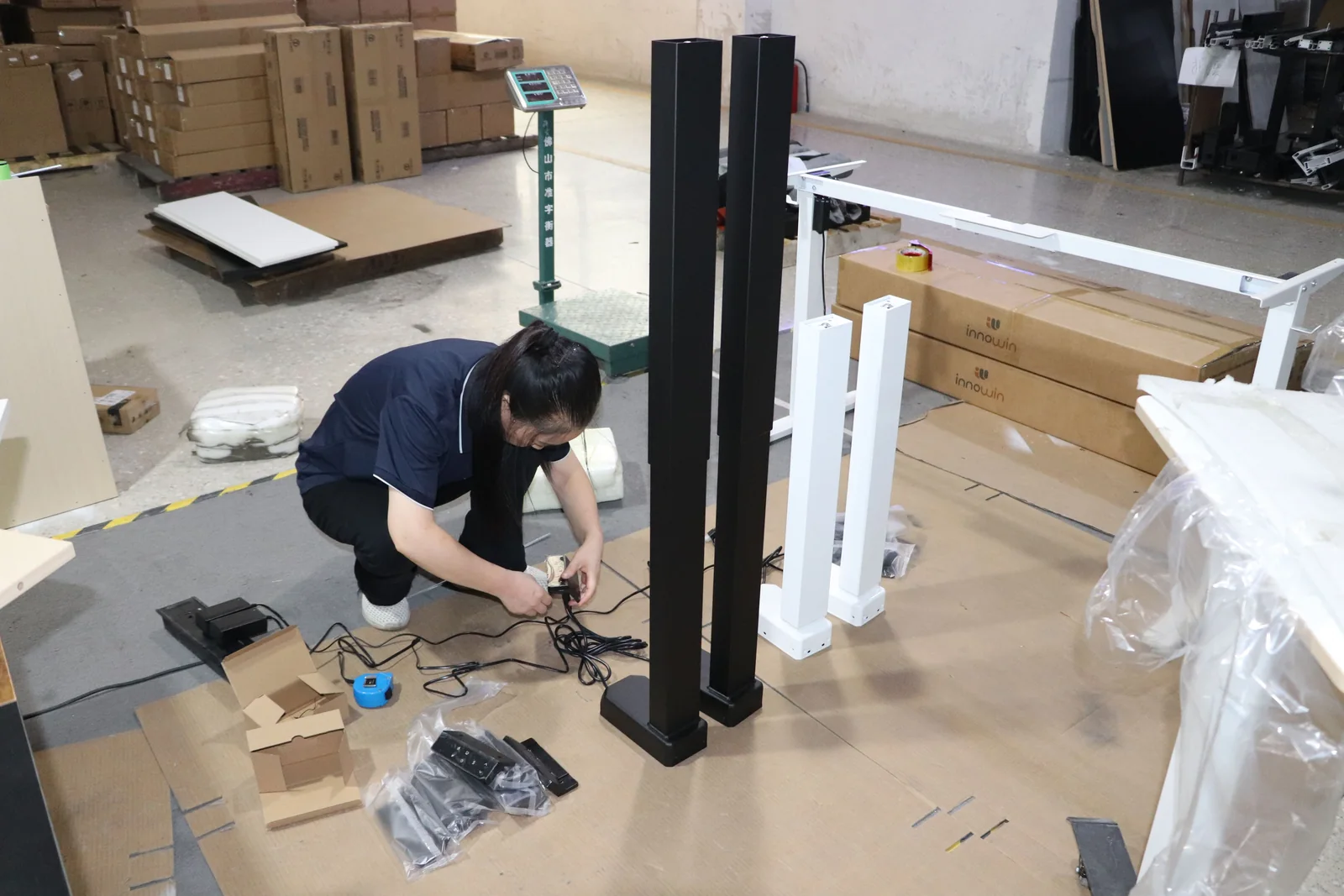
A single-motor frame generally uses one motor to drive the lifting mechanism. A dual-motor frame generally uses a motor at each lifting column or leg. The labels are not a complete technical description. Motion may be transferred mechanically, coordinated through the controller, or managed by several components.
Ask the supplier to identify the exact model and revision, motor count, column count, transmission arrangement, control box, handset, and compatible desktop. A proposal that says only “dual motor” leaves too much unresolved for a commercial comparison.
ANSI/BIFMA X5.5-2021 includes height-adjustable tables in its desk and table scope, so buyers should evaluate the desk product rather than one component (BIFMA, *Standards Descriptions*). This does not state that any particular frame meets a standard.
BUYER'S GUIDE
When Might a Single-Motor Frame Fit a Product Brief?
A single-motor option may be worth considering where the brief has a defined desk format, intended use, price position, and matching model-level specifications. Confirm the desktop range, configuration-changing accessories, load definition, and market documents. For a compact range, check workspace and base footprint alongside the drive choice; our guide to choosing a small standing desk covers those questions.
It belongs in the comparison when it clears the same non-negotiable requirements as the alternative—not because it is presumed lower-cost, quieter, or less stable. Obtain the commercial quote and evidence pack before deciding whether it fits the line.
BUYER'S GUIDE
When Might a Dual-Motor Frame Fit a Product Brief?
A dual-motor configuration may be a candidate when the brief calls for a particular desk setup, usage pattern, or evidence package. Ask how the lifting columns synchronize, what happens after an abnormal condition, and which complete frame configuration was assessed.
Use a short requirement-to-evidence table before treating a dual-motor proposal as comparable.
| Product Brief Question | Evidence to Request for the Exact Configuration | Decision Status |
|---|---|---|
| What desk and desktop is being evaluated? | Model, revision, desktop assumptions, accessories, and assembly instructions | Confirm / Open |
| How is lifting motion coordinated? | Drive-layout description, controller identification, and operating documentation | Confirm / Open |
| What load and usage conditions matter? | Rated-load definition and relevant model-level test basis | Confirm / Open |
| Which market will receive the product? | Applicable documentation identified for the target market and supply role | Confirm / Open |
| What support terms are quoted? | Written terms, exclusions, model applicability, and document date | Confirm / Open |
This asks the supplier to show whether the exact option can meet the brief, rather than inferring results from motor count.
BUYER'S GUIDE
Compare the Configurations on Evidence, Not Motor Count Alone
Build the comparison around like-for-like documentation. A speed figure without load, desk size, voltage, and method is not comparable with one measured under different conditions. The same applies to sound, cycle, capacity, and warranty claims.
| Comparison Field | Single-Motor Proposal | Dual-Motor Proposal | What Must Match or Be Explained |
|---|---|---|---|
| Exact model and revision | Drawing/specification revision and approved configuration | ||
| Motor count and drive layout | Motor, transmission, and column arrangement | ||
| Synchronization method | Controller logic and documentation scope | ||
| Speed and stated conditions | Load, voltage, travel range, sample, method, and date | ||
| Noise and stated conditions | Measurement distance, environment, load, method, and date | ||
| Load rating and basis | What is included in the load and how it was evaluated | ||
| Cycle evidence | Test method, configuration, cycles, result, executor, and date | ||
| Controls and safety functions | Handset/controller version and operating guidance | ||
| Warranty or service terms | Model, territory, exclusions, and written approval | ||
| Open questions | Named owner and response due before selection |
Check Synchronization, Controls, and the Complete Frame Configuration
Ask for a control-system description rather than relying on a feature name. Request controller and handset versions, operating instructions, relevant fault behaviour, and confirmation that documents apply to the quote.
Record the lifting columns, crossbeam, feet, fasteners, desktop mounting, and accessories. If a report applies to another desktop, feet, or controller, mark it non-comparable until the difference is explained.
Ask How Speed, Noise, Load, and Cycle Tests Were Measured
Request the method, sample, conditions, date, and testing party for each result. For speed, clarify direction, load, supply conditions, and height interval. For noise, record distance, environment, load, and other equipment. For load and cycles, confirm the tested configuration, load placement, criteria, and interruptions.
A third-party document is useful only if its scope matches the proposal. UL identifies load support, stability, pinch or entrapment, and electrical risks as relevant for height-adjustable desks; it identifies UL 962 as its primary standard for evaluating the furnishings (UL Solutions, *New Trends in the Office Furniture Industry: Height Adjustable Desks*). This is context for questions, not evidence that a particular frame was evaluated or certified.
BUYER'S GUIDE
Does Motor Count Determine Stability, Noise, or Lifting Performance?
No. Motor count alone does not determine stability, noise, speed, lifting performance, or durability. Structure, column and foot design, desktop, load placement, assembly, flooring, control behaviour, and conditions can affect the result. OSHA likewise advises reviewing work-surface and under-desk space rather than treating the mechanism as the entire ergonomic solution (OSHA, *Computer Workstations eTool: Desks*).
Use this evidence screen whenever a claim appears in a quotation, product listing, or sales presentation.
| Claim Under Review | Evidence to Request | Applicable Model and Setup |
|---|---|---|
| “More stable” | Test method or assessment basis, tabletop, load placement, height, and floor/installation conditions | |
| “Quieter” | Sound method, distance, environment, load, motion direction, and date | |
| “Faster” | Measured travel range, load, supply conditions, and controller version | |
| “Higher capacity” | Rated-load definition, included desktop/accessories, basis, and configuration | |
| “More durable” | Cycle-test scope, sample, acceptance criteria, executor, date, and report |
When the evidence is incomplete, the defensible answer is “not yet comparable.” Do not fill the gap with a rule of thumb about single or dual motors.
BUYER'S GUIDE
How to Match a Motor Option to Your Target Market and Product Line
Start with the product line, then select the evidence. List the intended user, desk format, expected equipment, feature position, target market, and rejected conditions.
For electrically powered desks, review documentation for the destination and supply role. In Great Britain, the government lists technical documentation, conformity assessment, marking, and a declaration of conformity among applicable pre-market obligations; importers have separate checks and traceability duties (UK Government, *Electrical Equipment Safety Regulations 2016: Great Britain*). Documents and responsibilities depend on the product and route to market.
For Australia, electrical safety guidance advises buyers to check the Regulatory Compliance Mark and the Electrical Equipment Safety System where relevant (Queensland Government, *Buying and Using Electrical Equipment*). This is not a promise of availability or compliance for any GB Ergonomic product. Ask the responsible supplier or qualified compliance adviser to confirm the requirements for the exact configuration and market.
| Product-Line Input | Single-Motor Option | Dual-Motor Option | Decision Question |
|---|---|---|---|
| Intended desk format and user | Does the documented setup match the intended application? | ||
| Required configuration and controls | Are all included and optional components identified? | ||
| Market documentation needs | Which documents apply, and who owns each action? | ||
| Evidence threshold | Is model-level evidence complete and comparable? | ||
| Non-acceptable conditions | What would remove the option from the shortlist? |
BUYER'S GUIDE
A Buyer’s Checklist for Comparing Supplier Proposals
Before comparing prices, align proposals to the same product definition.
- Record the exact frame model, revision, colour/finish, desktop assumptions, accessories, and market.
- Identify each motor, lifting column, drive arrangement, controller, handset, and power specification.
- Confirm which items are included, optional, excluded, or awaiting confirmation.
- Request speed, noise, load, and cycle records with method, conditions, date, and testing party.
- Match test evidence to the quoted configuration; flag different revisions or setup assumptions.
- Obtain operating, installation, and safety information applicable to the destination market.
- Record written warranty or support terms only where the supplier has approved them for the configuration and territory.
- Assign an owner and decision date to every open item before sampling or award.
For a fuller set of fields to control quote scope, revisions, inclusions, and exclusions, see the planned office furniture RFQ and quotation comparison guide. Relevant current configurations can also be explored on our standing desk products page.
BUYER'S GUIDE
How to Make a Defensible Shortlist Before Sampling
A defensible shortlist records why an option passed, needs more evidence, or was removed. Put non-negotiables first: intended configuration, market, necessary documents, installation constraints, and evidence threshold.
| Shortlist Outcome | When to Use It | Required Next Step |
|---|---|---|
| Advance to sample review | Model and revision are clear; evidence aligns with the target configuration | Confirm sample configuration and approval criteria |
| Hold for evidence | A material document, condition, or component detail is missing | Send a named clarification request and keep the item unranked |
| Exclude | The option conflicts with a non-negotiable brief requirement | Record the reason and retain supporting correspondence |
Sampling should verify the configuration that passed document review. Treat a component change as a new configuration question, not a performance guarantee.
FREQUENTLY ASKED QUESTIONS
Questions to settle before you request a quotation.
Is a Dual-Motor Standing Desk Frame Always Better Than a Single-Motor Frame?+
No. A dual-motor standing desk frame is not automatically better. Compare the exact configuration, synchronization system, intended desk setup, and like-for-like evidence for speed, noise, load, and cycle performance before deciding.
Is a Single-Motor Frame Less Stable?+
Not necessarily. Stability relates to the complete desk, including its lifting columns, feet, desktop, load placement, assembly, floor, and the conditions used to assess it. Motor count does not settle the question.
Are Dual-Motor Standing Desks Quieter?+
Do not assume so. To compare sound information, request the measurement distance, environment, load, motion direction, test method, model, and date for each result. Unmatched figures should be treated as non-comparable.
What Motor-Related Evidence Should I Request From a Supplier?+
Request the model and revision, motor count and drive layout, synchronization and controller details, compatible desktop, and evidence for speed, noise, load, and cycles with conditions, dates, and testing party. Also request relevant market instructions and documents.
RELATED BUYER GUIDES
Continue with the next practical question.
Each guide below develops the product, evidence or commercial question that naturally follows this one.
STANDING DESKS
Standing Desk Frame Buyer’s Guide: How to Choose the Right Electric Base
Compare electric bases through final configuration, evidence, controls and a like-for-like commercial brief.
SOURCING
Frame-Only or Complete Desk? How to Choose the Right Standing Desk Supply Model
Understand the trade-offs across product ownership, tabletop integration, packing and customer service.
OEM PROCUREMENT
How to Write an Office Furniture OEM RFQ and Compare Quotations
Make supplier quotes comparable by defining specifications, packaging, destination and decision criteria.
READY TO MAKE A MORE INFORMED DECISION?
Request Matched Motor-Option Specifications
If you are shortlisting a standing-desk range, share your target desk configuration and destination market. [Contact GB Ergonomic](/contact) to ask which currently available motor-option specifications and test documents can be reviewed for that defined request. For broader procurement material, visit our [resources](/resources) page.
Get a focused responseSOURCES AND FURTHER READING
The references below support the standards, procurement and workplace context in this guide. Requirements should always be verified against the exact product configuration, destination market and commercial arrangement.
ABOUT THIS GUIDE
Written by the GB Ergonomic Editorial Team and reviewed on October 27, 2026. This is an educational buyer resource, not legal, certification or regulatory advice. Product evidence, standards and commercial terms should be confirmed for the exact configuration and destination market.